Agents
What's the H2O AI Super Agent?
Enterprise h2oGPTe agents are general-purpose, code-first AI agents. They pick tools, write code, run it, fix errors, and keep iterating until they finish the task.
Unlike frameworks such as LangGraph or CrewAI, where each agent targets one specific workflow, an H2O agent isn't tied to a playbook. The same request can produce different solutions on different runs because the agent adapts to context, available tools, and what it learned from earlier steps.
The Agents button in the chat composer switches a chat session from question-and-answer to autonomous task execution.
Proven performance: #1 on FutureX
The H2O AI Super Agent ranks #1 on the FutureX leaderboard, a contamination-free benchmark from researchers at ByteDance Seed, Fudan University, Stanford University, and Princeton University that tests AI agents on predicting real-world future events. H2O.ai holds three of the top four positions, ahead of agents from OpenAI, Google, DeepSeek, and xAI.
FutureX evaluates around 500 events per week across 11 domains (finance, technology, sports, politics, healthcare, and more) from 195 websites, with difficulty-weighted scoring.
What agents can do out of the box
With no configuration, an agent has access to:
See Agent tool configuration for the full list of built-in tools and their configuration parameters.
Agent flavors
The General Agent is the core H2O AI Super Agent. With the right settings and prompt, it can handle most tasks. h2oGPTe also includes purpose-built flavors for common workflows, plus specialized flavors for building tools and custom agents.
Core flavors
Specialized flavors
To select an agent flavor:
- From the h2oGPTe dashboard, click + New chat.
- Click the Agents button in the chat composer.
- Pick the flavor that matches your task.
Start with General Agent if you're not sure. The specialized flavors just get to the answer faster on their target task.
Accuracy levels
Each flavor supports four accuracy levels. They control how many turns the agent can take and how long it can spend per turn.
| Level | Turns | Time | Use it for |
|---|---|---|---|
| Quick | 10 | 30 s | Fast lookups and simple answers |
| Basic | 20 | 60 s | Single-step tasks |
| Standard | 40 | 120 s | Most tasks (default) |
| Maximum | 80 | 240 s | Complex analysis where accuracy matters more than speed |
Higher accuracy improves results on hard tasks at the cost of time.
Customize agents with collections
Connect an agent to a collection to give it access to your documents. The agent can search and reason over the collection alongside its built-in tools, which turns a general-purpose agent into a domain-specific one.
RAG modes
How the agent interacts with your documents depends on the RAG (retrieval-augmented generation) mode:
| Mode | How it works | Best for |
|---|---|---|
| Agentic RAG | The agent decides when to query the documents | Complex questions that combine document knowledge with other tools |
| RLM RAG | A retrieval-language model with up to two retrieval iterations | Focused document questions where you want concise, grounded answers |
| Fast Agentic RAG | Document chunks load directly into the agent's context | Speed-sensitive queries over smaller document sets |
Custom tools
Upload your own code as a tool. A custom tool can:
- Accept structured inputs (for example, a company name).
- Run custom business logic (for example, look up that company's brand colors).
- Return a result the agent can use in the next step (for example, apply those colors to a chart).
Custom tools are user-owned and can be associated with agents. You configure them in the prompt settings. See Tool calling for details.
You can also turn agent-generated .py or .zip files into tools directly from the agent response, without downloading and re-uploading them. See Add files as tools.
Custom agents
If you need a specific orchestration pattern, build a custom agent in one of the supported frameworks:
- LangGraph for graph-based workflows.
- CrewAI for multi-agent collaboration.
- OpenAI Agents SDK for OpenAI-compatible agents.
- Claude for Anthropic Claude-based agents.
Package the agent as a ZIP file and upload it from the Agents tab.
To skip the framework work, describe what you want in the Agents Builder and h2oGPTe generates the code. The Agents Builder produces LangGraph, OpenAI Agents SDK, or CrewAI code. For Claude agents, package and upload the ZIP yourself.
How the pieces connect
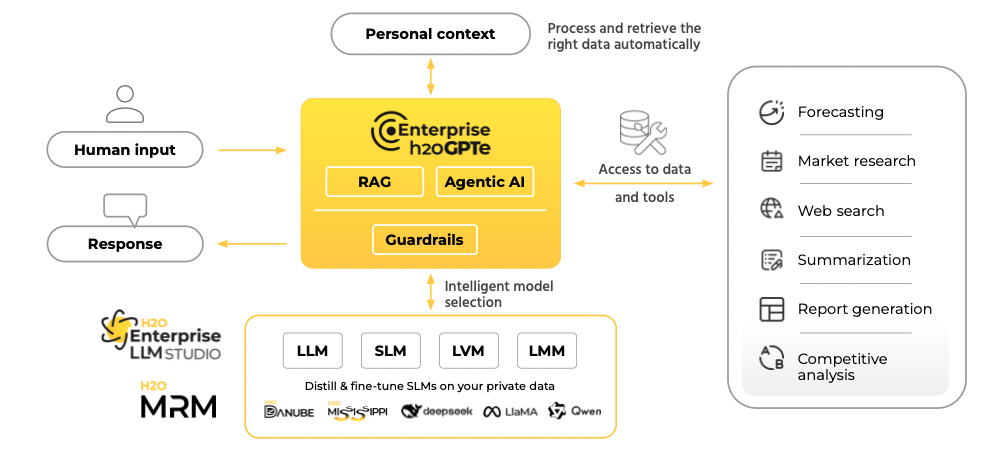
An h2oGPTe agent brings together these parts of the platform:
- Models: Agents use the LLM configured for the chat session (Claude, GPT, a local model, or a custom one). The model handles reasoning and tool selection.
- Tools: Built-in tools cover core capabilities. Custom tools and MCP servers extend the agent with your own code and external integrations.
- Files: Agents read uploaded files and can generate new ones (scripts, charts, documents, presentations) that you can download.
- Collections and RAG: Connect agents to document collections for domain-specific knowledge. Pick a RAG mode that fits your accuracy and speed needs.
- Access control: Admins control which tools and models agents can access, and who can create or manage custom agents and API keys.
- Evaluation: Use Eval Studio to score agent responses, compare configurations, and track performance over time.
Review agent behavior
To see how an agent completed (or is completing) a request:
- Choose a view mode. Click View at the top-right of the agent response to switch between Simplified (final response only), Standard (chain of thoughts visible), or Detailed (chain of thoughts plus the right panel opens automatically). See Agent response view for details.
- Open the right panel. Click Details to open the right panel. It contains tabs for Steps (an organized timeline of code generation, execution, and results), Files (the agent files stored for the chat session), Sources (external web references), Thoughts (how the agent chooses tools and plans its approach), and Chat (internal agent-to-agent logs).
- Review the plan before execution. When the agent has a plan ready, review it. Approve it as-is or change it before the agent runs.
- Download outputs. In the right panel, click Files, then click the menu icon. From there, you can Download files, Import to collection, Add files as tools, or — if your admin has enabled custom agents — Add Files As Agent.
- Get an email when the run finishes. While the agent runs, click the bell icon in the agent response header. See Get an email when a run finishes.
Tutorials
- Tutorial 5: Dataset analysis with agents
- Tutorial 6: Model development and preparation with agents
- Tutorial 9: Creating and using a custom agent tool
- Tutorial 12: Loan amount prediction using DAI agents
- Submit and view feedback for this page
- Send feedback about Enterprise h2oGPTe to cloud-feedback@h2o.ai