Manage collections
Overview
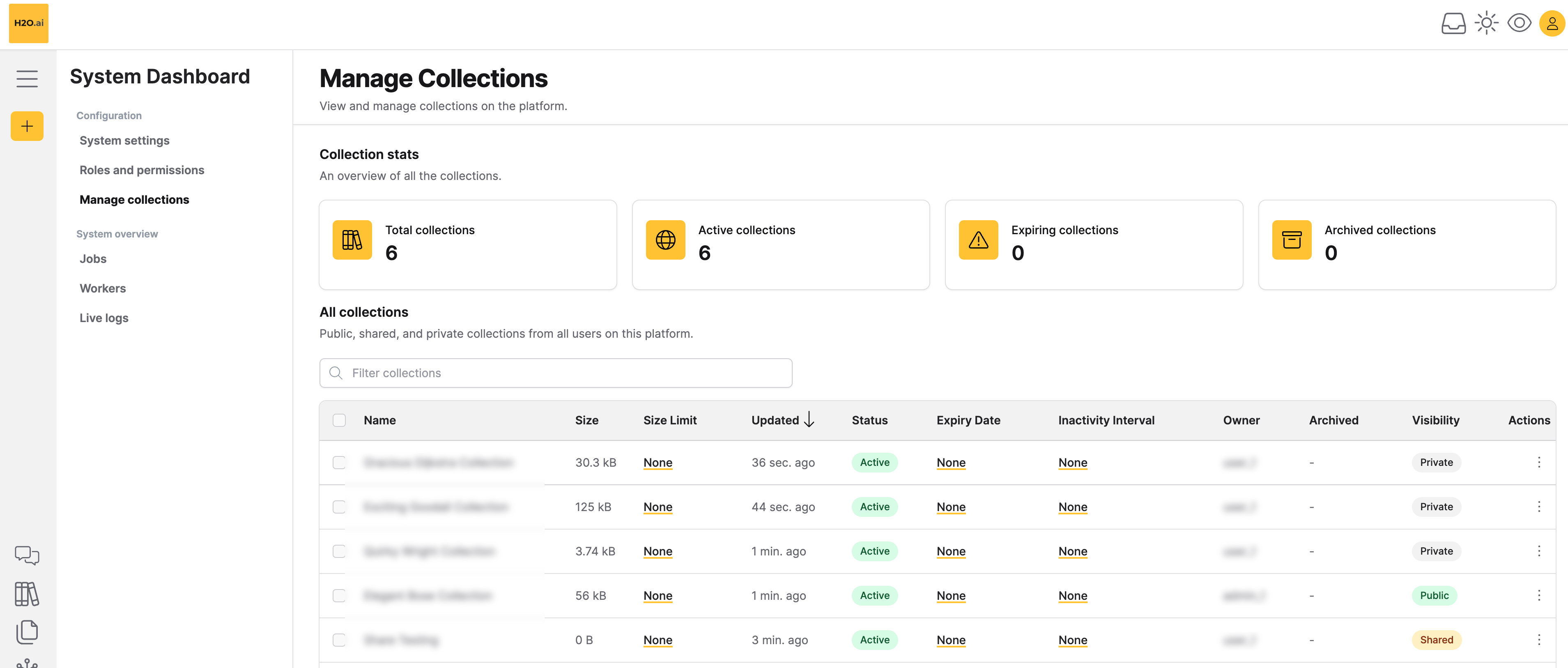
The Manage collections section on the System Dashboard page provides an overview of all collections on the platform. It displays detailed information about public, shared, and private collections, including the owner, status, size, and scope (public, private, or shared). This helps administrators identify who created each collection and monitor their status across the platform.
Set a size limit for a Collection
Overview
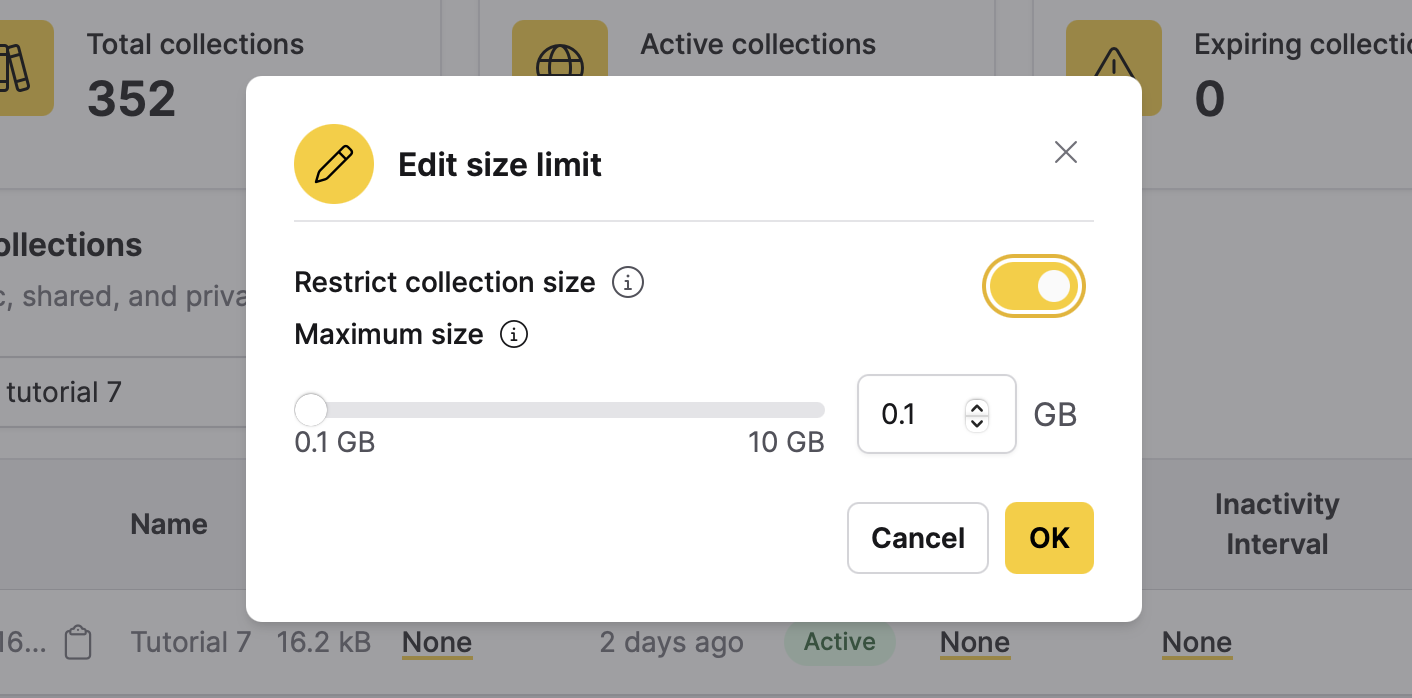
In the Admin Center, under the Collections tab, you can set a size limit for a collection by specifying the maximum allowed size in gigabytes (GB). This limit represents the total size of all documents within the collection.
Admins can set a size limit that is smaller than the current total size of a collection. Doing so does not remove or affect existing documents. However, it prevents users from adding more documents to the collection until the total size falls below the set limit (for example, by deleting existing documents).
Instructions
To set the size limit of a Collection for the first time, consider the following steps:
- In Enterprise h2oGPTe, click Account Circle.
- Select System Dashboard.
- In the System Dashboard navigation menu, click Manage collections.
- In the All collections table, locate the Collection for which you want to set its size.
- In the Size Limit column, click None (the current size limit of the Collection).
- Click the Restrict collection size toggle.
- In the Maximum size, set a size limit in GBs.
- Click Ok.
Set an expiration date for a Collection
Overview
You can set a Collection's expiration date in the Admin Center, under the Collections tab. Once it expires, the collection will be archived, allowing an admin to recover it. If no action is taken before the globally configured Collection Expiration Limit (days) elapses after expiration, the Collection will be permanently deleted.
The global Collection Expiration Limit (days) setting (configured by an Admin) controls:
- Archive retention period: how long an archived Collection remains available before it is automatically and permanently deleted.
- Expiring warning window: how far in advance of its expiry date a Collection is marked with the Expiring status in the UI.
For example, if the Collection Expiration Limit (days) is set to 7, a Collection that will expire in 7 days is shown as Expiring in the UI. When that Collection reaches its expiry date and is archived, it will then be automatically deleted 7 days later (unless an Admin recovers it before deletion).
Once a Collection is archived, it becomes inaccessible to the owner and any user with access to it, including its data, such as chats and documents. An Admin can view and recover the archived Collection.
Instructions
To set an expiration date for a Collection for the first time, consider the following steps:
- In Enterprise h2oGPTe, click Account Circle.
- Select System Dashboard.
- In the System Dashboard navigation menu, click Manage collections.
- In the All collections table, locate the Collection for which you want to set its expiration date.
- In the Expiry Date column, click None (the current expiration date of the Collection).
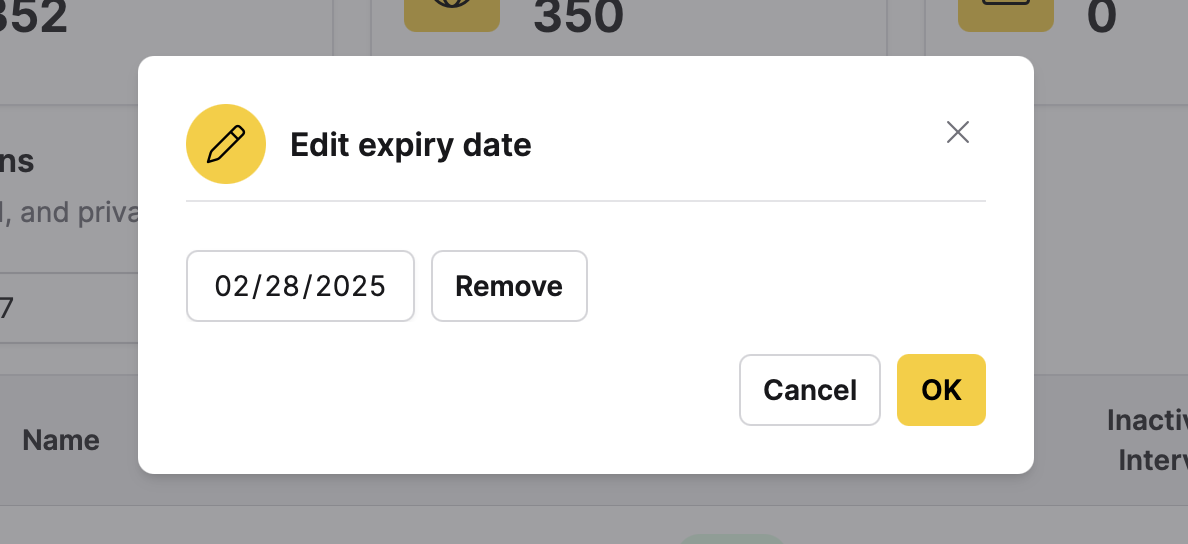
- In the Edit expiry date card, set an expiration date.
note
If the set expiry date falls within the next number of days defined by the global Collection Expiration Limit (days) setting, the Collection Status will be marked as Expiring.
- Click Ok.
Set an inactivity interval for a Collection
Overview
In the Admin Center, under the Manage collections tab, you can set the number of days a Collection can remain inactive before it automatically expires. Once expired, the Collection will be archived, allowing an Admin to recover it. If no action is taken before the globally configured Collection Expiration Limit (days) elapses after expiration, the Collection will be permanently deleted.
Once a Collection is archived, it becomes inaccessible to the owner and any user with access to it, including its data, such as chats and documents. An Admin can view and recover the archived Collection.
Instructions
To set an inactivity interval for a Collection for the first time, consider the following steps:
- In Enterprise h2oGPTe, click Account Circle.
- Select System Dashboard.
- In the System Dashboard navigation menu, click Manage collections.
- In the All collections table, locate the Collection for which you want to set its expiration date.
- In the Inactivity Interval column, click None (the current inactivity interval of the Collection).
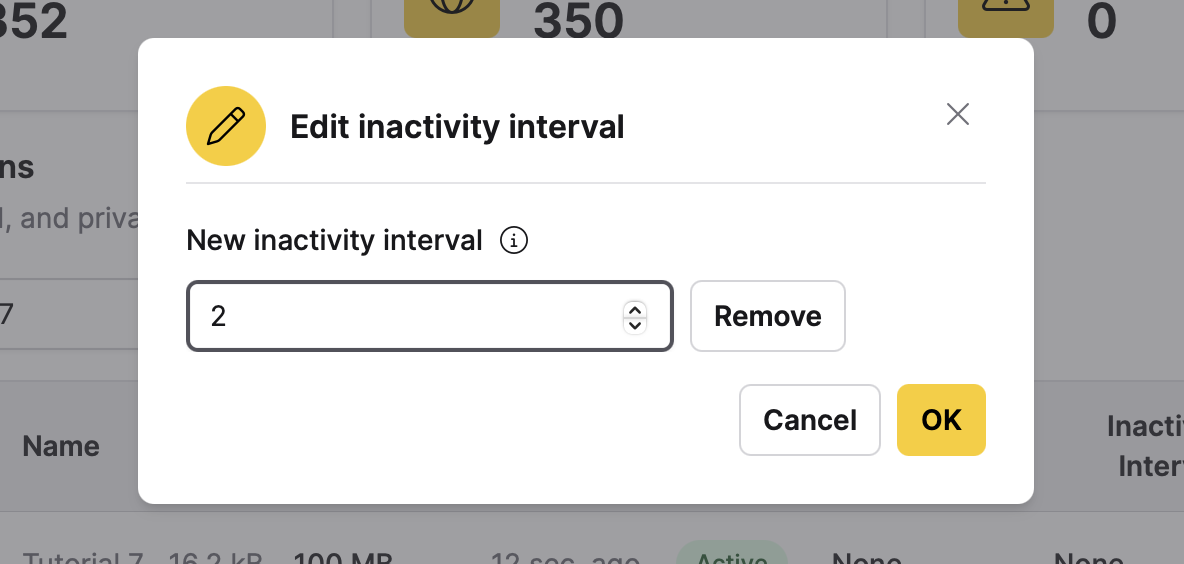
- In the New inactivity interval box, enter a number which refers to the number of days a Collection can remain inactive before it automatically expires.
- Click Ok.
Exempt a Collection from chat auto-archive
Overview
The global Chat Session Inactivity Limit (days) setting applies to every chat session, including the chats inside a Collection. In the Manage collections table, an Admin can exempt a single Collection from that global policy. The Global Chat Expiry column shows Exempt for a Collection that currently carries the exemption.
The exemption covers the global inactivity policy only. A chat expiry date that a user set explicitly still applies. For what the exemption changes and how Collection-level and chat-level deadlines combine, see Chat lifecycle.
You can only change the exemption on an active Collection. The action fails for a Collection that h2oGPTe already archived.
Instructions
To exempt a Collection's chats from the global chat inactivity limit, consider the following steps:
- In Enterprise h2oGPTe, click Account Circle.
- Select System Dashboard.
- In the System Dashboard navigation menu, click Manage collections.
- In the All collections table, locate the Collection you want to exempt.
- Click Action menu.
- Click Exempt chats from global inactivity limit.
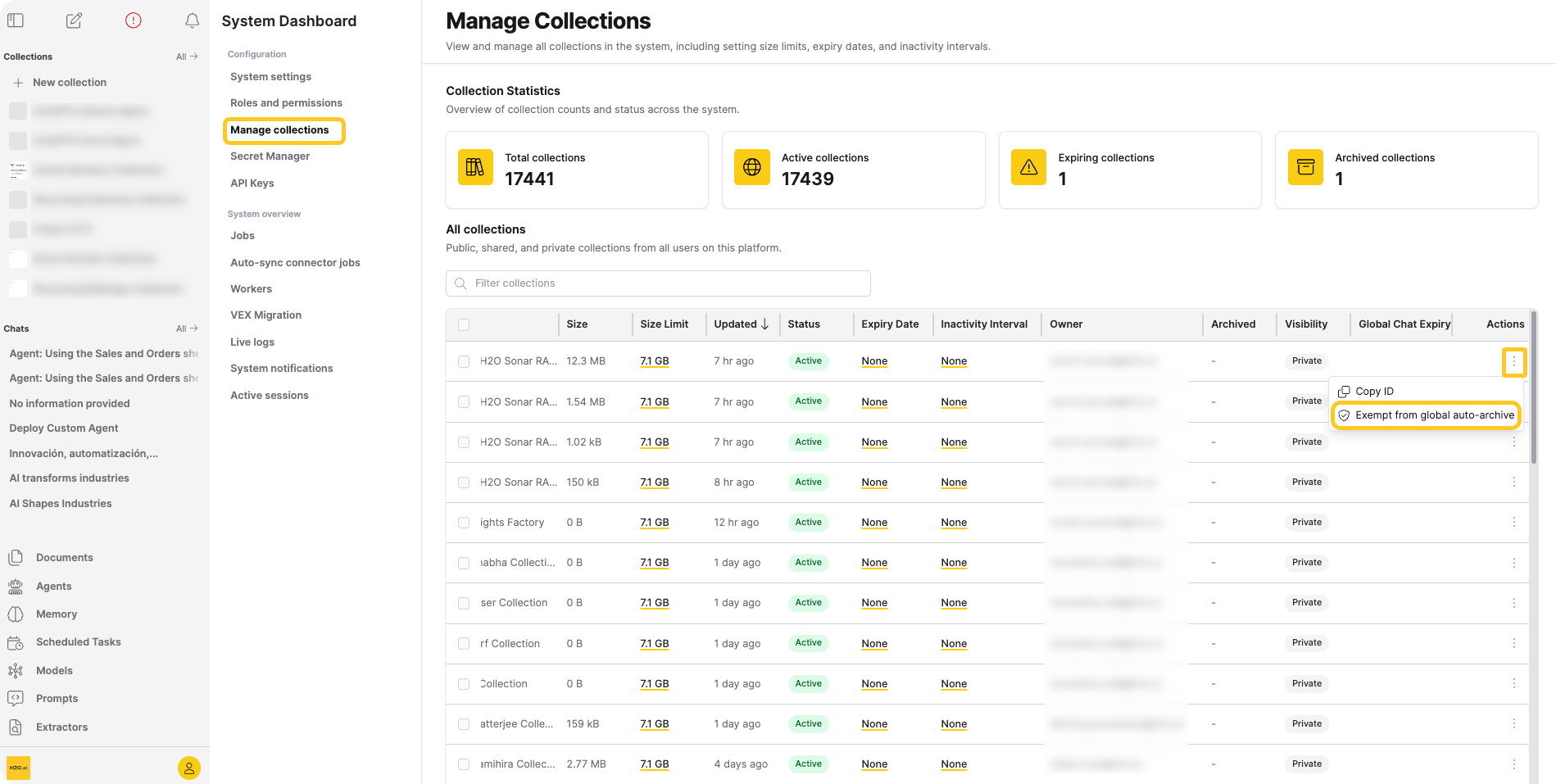
The Global Chat Expiry column now shows Exempt for that Collection. To reverse the change, repeat the steps and click Remove global chat inactivity limit exemption.
Recover a Collection
Overview
In the Admin Center, under the Manage collections tab, an Admin can recover an expired Collection. If no action is taken before the globally configured Collection Expiration Limit (days) elapses after expiration, the Collection will be permanently deleted.
Instructions
To recover an expired Collection, consider the following steps:
- In Enterprise h2oGPTe, click Account Circle.
- Select System Dashboard.
- In the System Dashboard navigation menu, click Manage collections.
- In the All collections table, locate the Collection you want to recover.
- Click Action menu.
- Click Recover collection.
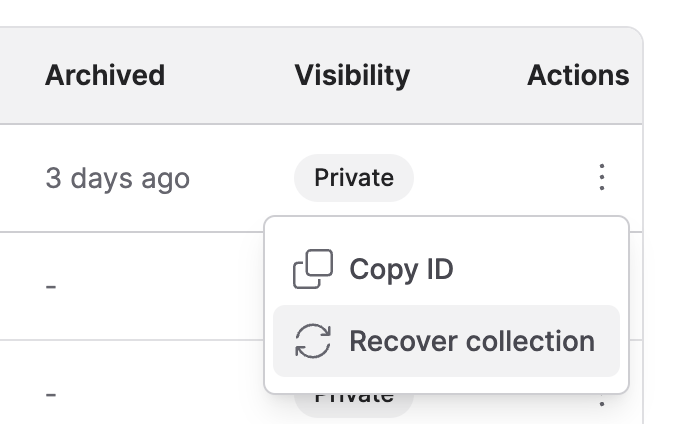
- Click Recover.
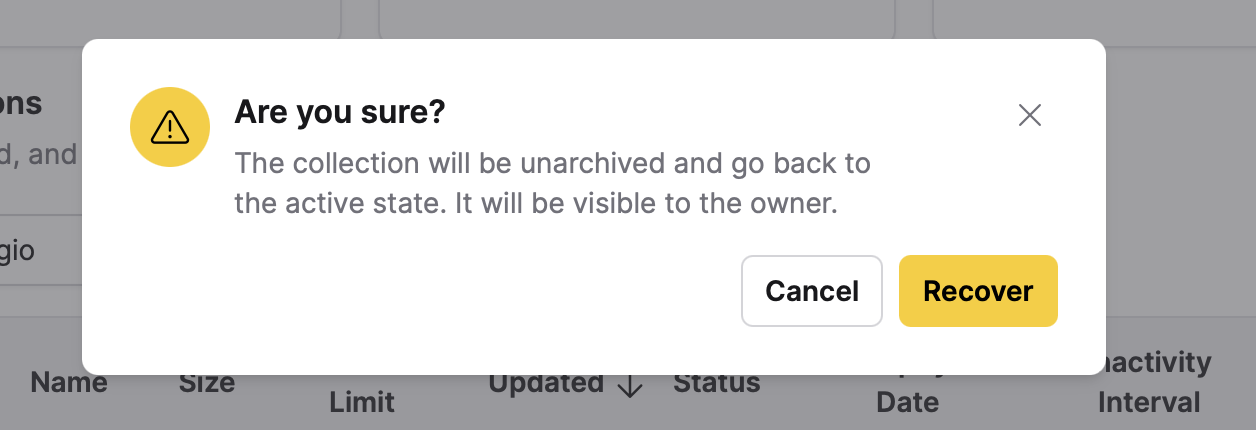
- Submit and view feedback for this page
- Send feedback about Enterprise h2oGPTe to cloud-feedback@h2o.ai